At 8:15 PM, the dinner rush was in full swing.
Flames leapt from burners. Fryers hissed. Steam rolled upward in thick waves.
And in the middle of it all stood Arvind, the commercial kitchen manager, wiping sweat from his forehead.
The problem wasn’t just heat. It was ventilation.
Despite multiple exhaust units running at full speed, the kitchen temperature hovered around 41–43°C during peak hours. Staff fatigue increased. Odour lingered longer than expected. And electricity bills kept climbing.
That’s when Arvind decided to rethink the exhaust system.
The Problem: Heat, Fumes, and Rising Costs
Commercial kitchens are high-intensity environments. Continuous cooking generates smoke, oil vapours, and heat that must be extracted efficiently.
But conventional induction exhaust fans often struggle in three areas:
- Heat accumulation due to inefficient motors
- Delayed fume clearance, leading to lingering odours
- Higher electricity consumption during long operating hours
In Arvind’s case, the fans were consuming significant power but still failing to clear fumes quickly. Average fume clearance time after a peak cooking burst was nearly 3–4 minutes. Staff frequently complained of discomfort and eye irritation.
Monthly electricity consumption from ventilation alone was exceeding projections by nearly 18%.
The Experiment: Switching to BLDC Exhaust Fans
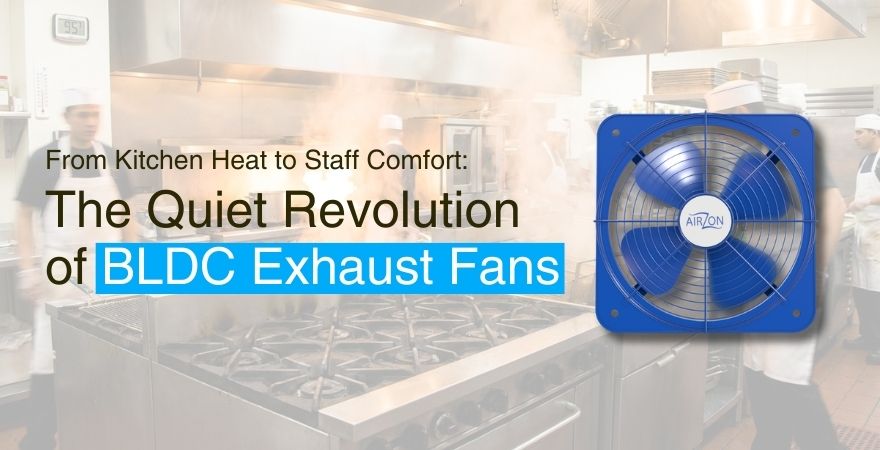
Instead of adding more fans, Arvind explored upgrading the technology itself. He chose BLDC exhaust fans designed specifically for commercial kitchen environments.
The objective was simple:
- Improve airflow efficiency
- Reduce internal motor heat
- Stabilize performance under voltage fluctuations
- Lower operating costs
Unlike conventional motors, BLDC exhaust fans use electronic commutation, converting power more efficiently into airflow rather than heat.
Installation was completed within days. The real test began that evening.
The Results: Measurable Change
Within the first week, the difference was noticeable.
Temperature Reduction
Peak kitchen temperatures dropped by approximately 3–5°C, improving overall comfort during high-load hours.
Faster Fume Clearance
Fume clearance time reduced from 3–4 minutes to nearly 90 seconds, keeping air visibly clearer and reducing odour persistence.
Lower Energy Consumption
Electricity usage from exhaust operations decreased by roughly 30–35%, thanks to lower power draw and stable RPM control.
Reduced Maintenance Calls
Because BLDC motors generate less internal heat, bearing stress and winding fatigue were significantly lower. No overheating complaints were reported during the first six months.
Why BLDC Exhaust Fans Work Better in Commercial Kitchens
Commercial kitchens operate for 10–16 hours daily. In such conditions, motor efficiency and construction quality make a critical difference.
Key factors behind the improvement:
- Lower internal heat generation, reducing stress on components
- Stable performance under voltage variations
- Plastic-free, all-metal construction, preventing deformation under high ambient temperatures
- Consistent airflow output, even during peak load periods
Unlike conventional fans that lose efficiency as heat builds up, BLDC exhaust fans maintain predictable performance across long shifts.
Beyond Comfort: Safety and Productivity
Improved ventilation does more than cool the space.
Better fume extraction enhances:
- Fire safety by reducing grease-laden air
- Worker alertness and morale
- Hygiene standards
- Equipment lifespan
For Arvind, the biggest change wasn’t just the energy bill — it was staff feedback. Fewer complaints. Less fatigue. Smoother operations.
The Quiet Revolution
The shift from conventional to BLDC exhaust fans in commercial kitchens doesn’t make headlines. It doesn’t change recipes or customer menus.
But it transforms the environment behind the scenes.
From reduced heat to faster fume extraction and measurable energy savings, BLDC technology quietly improves what matters most — safety, comfort, and operational efficiency.
Sometimes, the biggest upgrades aren’t louder.
They’re simply smarter.