On the first Monday of every month, Rajiv, a plant manager at a mid-sized manufacturing unit, reviews the electricity bill before his morning coffee.
The number he checks first isn’t total consumption.
It’s peak demand.
That single line item — measured in kVA — often costs more than expected. And it’s not about how much energy the factory used over 30 days. It’s about the highest load the grid recorded at any one time.
That’s where the hidden cost lives.
The Line Item No One Talks About
Most factories focus on energy efficiency in terms of kilowatt-hours consumed. But utilities penalize facilities for high peak demand — the highest load drawn during the billing cycle.
When production ramps up, HVAC systems kick in. Large exhaust units run at full power. Cooling systems surge. And suddenly, the facility hits its monthly demand peak.
Even if that spike lasts 30 minutes, it impacts the entire bill.
Rajiv noticed that during summer months, peak demand rose by nearly 12–15%, even though overall production remained stable.
The culprit? Cooling load.
Rethinking Cooling: Not Just Comfort, but Strategy
Instead of expanding HVAC capacity — which meant higher capital expenditure and larger demand spikes — Rajiv explored a different approach: improving air circulation.
This is where ceiling fans peak demand reduction strategies come into play.
High-volume BLDC ceiling fans and industrial air circulators don’t replace HVAC entirely. But they reduce dependency on it.
By improving air movement and temperature distribution, factories can:
- Raise thermostat setpoints by 2–3°C
- Reduce compressor cycling frequency
- Lower instantaneous load during peak hours
The result? Lower peak demand.
Walking Through the Ledger
Rajiv’s finance team tracked a three-month pilot.
Before BLDC Ceiling Fans:
- Peak demand: 410 kVA
- HVAC load during peak: ~160 kVA
- Compressor cycles: Frequent during 2–5 PM
After Installing BLDC Ceiling & Circulator Strategy:
- Peak demand reduced to 365 kVA
- HVAC load during peak lowered by approx. 20–25 kVA
- Compressor cycling reduced significantly
That reduction translated into noticeable savings — not just in energy use, but in demand penalties avoided.
More importantly, it delayed the need for HVAC capacity expansion.
Why BLDC Makes the Difference
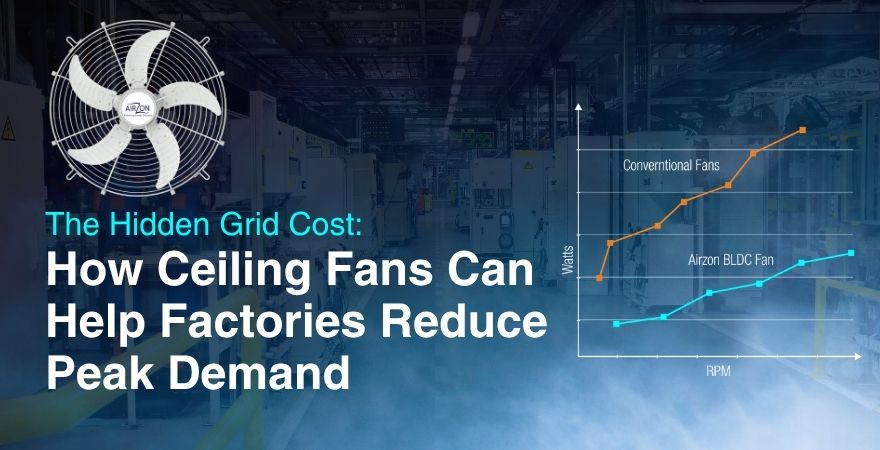
Conventional ceiling fans consume more power and generate more internal heat. During peak hours, even auxiliary systems contribute to grid stress.
BLDC ceiling fans operate differently.
- Lower wattage per unit
- Stable RPM under voltage variation
- Reduced internal heat generation
- Efficient airflow distribution
Because BLDC fans use significantly less power, adding more units for circulation doesn’t inflate peak demand the way traditional motors do.
In fact, they help offset it.
Beyond Numbers: Operational Stability
Reducing peak demand isn’t just about saving on penalties. It improves electrical stability within the facility.
Lower peak loads mean:
- Reduced transformer stress
- Lower internal distribution losses
- Better equipment lifespan
- Improved grid compliance
And from a finance perspective, it enhances predictability.
Rajiv’s ledger told a clear story: improved airflow reduced cooling spikes, which lowered peak demand, which stabilized operational costs.
Airzon’s Role in Smarter Cooling Strategy
Airzon’s BLDC ceiling and air circulator fans are engineered for continuous industrial use.
Key characteristics supporting peak demand reduction:
- Energy-efficient BLDC motors
- Plastic-free, all-metal construction
- Designed for long operating hours
- Stable performance even during voltage fluctuations
By focusing on airflow efficiency per watt, Airzon’s design philosophy aligns directly with facilities aiming to reduce instantaneous load rather than just monthly consumption.
The Bigger Financial Picture
When cooling is viewed only as comfort, it remains an expense.
When cooling becomes a grid strategy, it becomes leverage.
Ceiling fans peak demand reduction isn’t a theory. It’s an operational shift — one that connects engineering decisions with financial outcomes.
Rajiv now checks his peak demand line with less anxiety.
Because sometimes, lowering the biggest number on the bill doesn’t require bigger machines.
It requires smarter airflow.