It rarely begins with a breakdown.
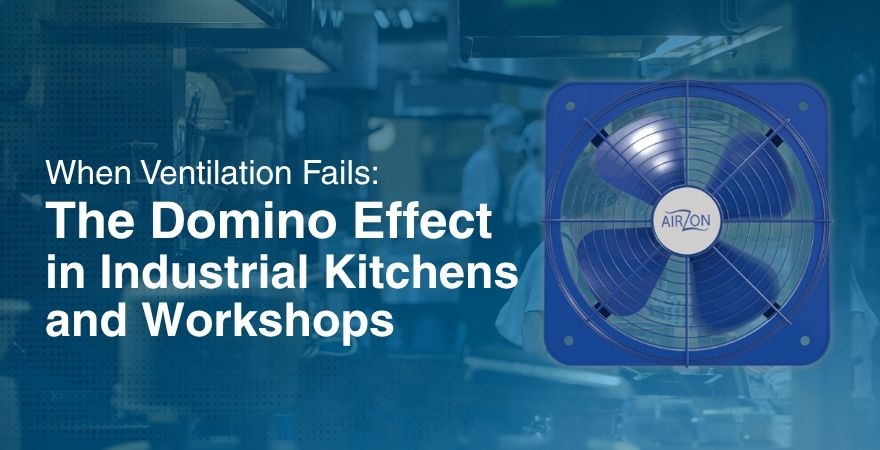
In most industrial kitchens and workshops, ventilation failure starts quietly. The exhaust fan still runs. Air still moves. But something shifts — and that shift triggers a chain reaction.
By the time the real problem is noticed, productivity has already taken a hit.
The First Domino: Poor Industrial Exhaust Fan Performance
In a large commercial kitchen operating 14 hours a day, peak cooking hours push temperatures beyond 40°C. The exhaust system, designed years ago, struggles to clear fumes quickly.
On paper, the fan delivers sufficient airflow. In reality, industrial exhaust fan performance degrades under continuous heat load.
Smoke lingers longer. Grease-laden air builds up. Ambient temperature rises steadily.
No alarms sound. But the first domino has fallen.
The Second Domino: Heat Buildup
When exhaust efficiency drops, heat accumulates faster than it’s removed.
In workshops, this means welding fumes hang heavier. In kitchens, it means staff operate in air thick with heat and vapour.
Ambient temperature climbs by 3–5°C beyond normal. It doesn’t feel dramatic — just uncomfortable enough to matter.
Machines also absorb this excess heat. Electrical panels warm. Bearings experience higher stress. Motors run hotter.
Heat doesn’t announce itself loudly. It builds patiently.
The Third Domino: Worker Fatigue
Fatigue doesn’t show up on dashboards. But it shows up in human performance.
Studies consistently link high ambient temperature with:
- Reduced concentration
- Slower reaction times
- Higher error rates
- Increased safety risk
In kitchens, cooks tire faster. In workshops, welders take longer breaks. Small inefficiencies compound across shifts.
Productivity doesn’t collapse overnight. It erodes.
The Fourth Domino: Productivity Drop
When fatigue sets in and temperatures remain high, output slows.
In one mid-sized fabrication unit, management noticed a 7–9% dip in post-lunch productivity during summer months. Equipment checks showed no major faults.
The issue traced back to inadequate ventilation performance.
Cooling systems tried compensating, but HVAC loads increased. Electricity consumption rose nearly 15% during peak production hours.
Poor ventilation had triggered both human and mechanical inefficiencies.
The Final Domino: Maintenance and Downtime
Heat and inconsistent airflow accelerate wear.
Conventional induction exhaust fans generate internal heat during long duty cycles. Under voltage fluctuations — common in industrial zones — motor stress increases further.
Over time, this leads to:
- Frequent bearing replacements
- Winding rewinds
- Motor overheating complaints
- Emergency maintenance calls
The exhaust system, meant to support operations, becomes a liability.
Breaking the Domino Chain with BLDC Exhaust Fans
The solution in both cases wasn’t simply adding more fans. It was upgrading to BLDC exhaust fans designed for continuous industrial duty.
BLDC technology converts power more efficiently into airflow, generating significantly less internal heat.
Key improvements observed:
- Faster fume clearance times (reduced by nearly 40%)
- Stable RPM under voltage variation
- Lower power consumption
- Reduced maintenance interventions
When paired with plastic-free, all-metal construction, durability improves even in high-temperature environments.
Unlike conventional fans that lose efficiency as heat builds, BLDC exhaust fans maintain consistent industrial exhaust fan performance throughout long shifts.
Ventilation Is Not a Background System
Ventilation is often treated as secondary — something that just needs to run.
But when it fails, even subtly, the consequences ripple outward:
Heat buildup → worker fatigue → productivity loss → maintenance costs.
Improving exhaust performance isn’t about louder airflow. It’s about reliable airflow.
And in industrial kitchens and workshops, reliability protects more than comfort.
It protects operations.