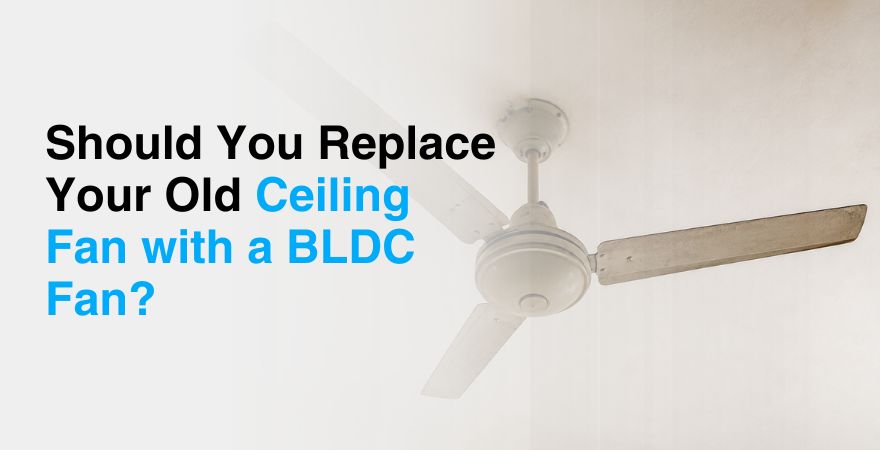
An old ceiling fan may still be working. It may still rotate at full speed. It may still create airflow. It may still look perfectly fine from the outside. But the real question is different. How much electricity is that old fan consuming every day? In Indian homes, offices, classrooms, shops and commercial spaces, ceiling fans run for long hours. In summer, many fans run for 12 to 16 hours a day. One fan may not look like a major power consumer. But when many fans run together, the electricity cost becomes visible.
The Problem with Old Fans
Most conventional ceiling fans use induction motor technology. These fans are simple and familiar, but they usually consume much more power than BLDC fans. A fan that was bought years ago may not have been selected for energy efficiency. It may have been selected for price, availability or design. That was normal at the time. But energy cost has changed. Today, a fan is not only a comfort product. It is a daily operating cost.
Why BLDC Makes Sense
BLDC stands for Brushless Direct Current. In simple words, it is a more efficient motor technology. A BLDC fan reduces energy loss, runs with lower power consumption and delivers reliable airflow. It also brings practical features such as remote control, timer functions and better speed control. This makes the transition useful for homes, offices, hotels, schools, event halls and commercial spaces where fans run for long hours.
When Replacement Becomes Practical
You do not need to replace every fan immediately. But if a fan runs daily for long hours, replacing it with a BLDC fan can make practical sense. The higher purchase cost can be recovered over time through electricity savings. For spaces with multiple fans, the benefit becomes stronger. One fan saves a little. Many fans save every month.
Airzon Angle
Airzon BLDC Ceiling Fans are designed for this shift from ordinary air movement to energy-efficient comfort. With remote/regulator operation, 5-speed control, 1200 mm and 1400 mm sweep options, and up to 60%+ energy savings, they help users move towards smarter cooling.