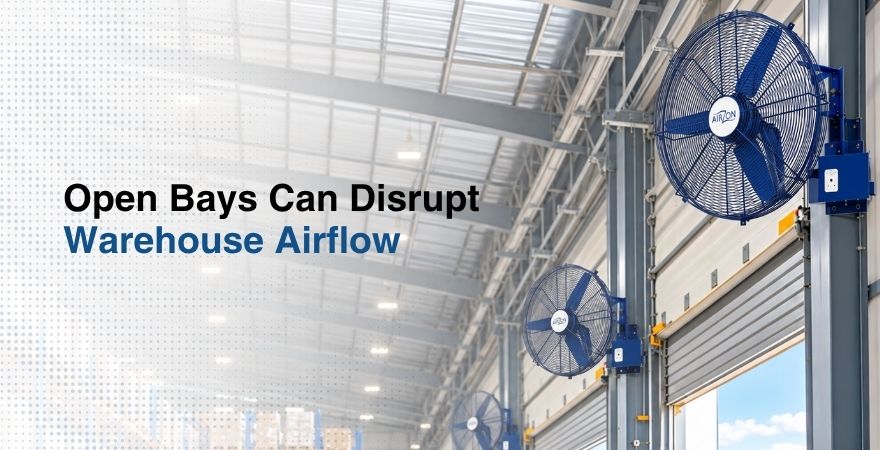
Warehouse doors and loading bays are essential for daily operations. They are also one of the most overlooked factors when planning warehouse air circulation.
Throughout the day, shutters and loading doors may open repeatedly as vehicles arrive, goods are unloaded, and material moves in and out of the facility.
Every time a large door opens, the airflow pattern inside the warehouse can change.
Outside air enters the building while conditioned or circulating air moves toward the opening. Depending on the weather, this can introduce heat, humidity, dust, or still air into the warehouse.
The result can be noticeable.
An area that feels comfortable when the doors are closed may suddenly become warmer once loading activity begins. Fans positioned near open bays may also direct a significant portion of their airflow toward the exit instead of deeper into the warehouse.
This is why warehouse cooling should be planned around actual operations.
Loading zones often need a different airflow approach compared with storage aisles, packing stations, or employee work areas. Fan placement should consider door locations, loading schedules, internal movement, and the direction in which air travels when doors remain open.
Industrial air circulator fans can help maintain continuous air movement, but their effectiveness depends greatly on where and how they are positioned.
Instead of viewing the warehouse as one large cooling zone, businesses can divide it into functional areas and plan airflow accordingly.
A good warehouse cooling strategy works during real operating conditions, not just when the facility is quiet and every door is closed.
If loading bays or frequently opened doors are affecting comfort inside your warehouse, speak with Team Airzon about planning an air circulation system around your actual facility layout.