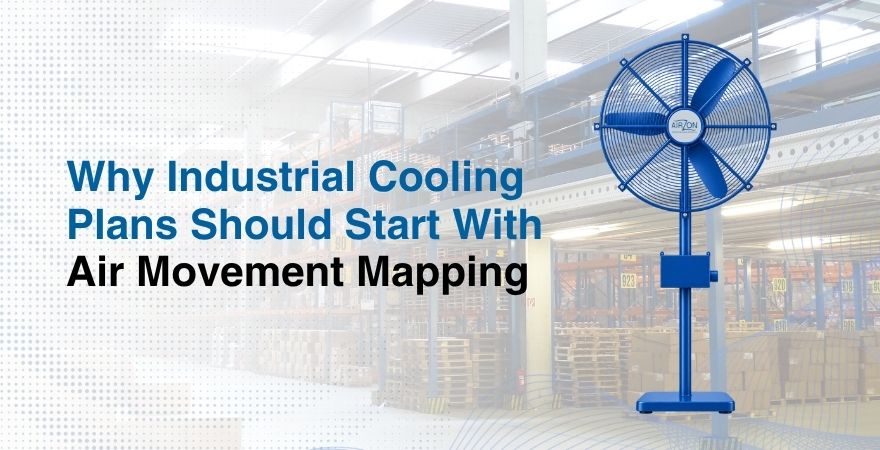
Industrial cooling is not simply about installing more fans. It is about understanding where the air needs to go.
In factories, warehouses, production units, and large commercial spaces, every area behaves differently. Machinery generates heat, racks interrupt airflow, walls create pockets of warm air, and people work in zones with different ventilation requirements. This is why an effective industrial cooling plan should begin with air movement mapping.
Air movement mapping helps identify how air currently travels through a facility. It highlights areas with poor circulation, excessive heat, blocked airflow, and unnecessary overlap between fans.
For example, placing several industrial fans in one section may create strong airflow there while leaving another working area uncomfortable. Adding more fans without understanding the airflow pattern can increase energy consumption without solving the actual cooling problem.
A better approach is to study the layout first.
Important factors include ceiling height, machinery placement, storage racks, doors, windows, heat generating processes, and employee workstations. Once these areas are understood, industrial air circulation fans can be positioned more effectively.
This is especially important in large facilities where uniform airflow is difficult to achieve.
Air movement mapping can also help businesses use BLDC air circulator fans more efficiently. Instead of selecting fans only on the basis of size or airflow capacity, the cooling solution can be planned according to the actual requirement of each zone.
Good industrial cooling begins before the fan is switched on. It begins by understanding the space.
If you are planning a new facility or reviewing an existing industrial cooling setup, call Team Airzon to understand how the right air circulation strategy can make a difference.