At 11:47 PM, most of the city is asleep.
But inside the factory floor, the night shift has just settled into rhythm.
Machines hum steadily. Conveyor belts move without pause. And in the middle of it all stands Ramesh, the shift supervisor, scanning temperatures on his handheld monitor.
For him, airflow isn’t comfort. It’s productivity.
The Real Challenge of the Night Shift
During the day, cooling systems get attention. Engineers are available. Maintenance teams are alert.
But after hours, the factory runs lean.
Night shifts bring unique operational challenges:
- Rising machine heat from continuous production
- Fewer maintenance staff on call
- Power fluctuations during off-peak grid adjustments
- Worker fatigue in warm, stagnant air
This is where airflow becomes mission-critical.
When Air Circulation Becomes Operational Strategy
Three years ago, this factory relied on conventional induction air circulators. They moved air — yes. But by 2 AM, heat built up around molding machines.
Motor temperatures increased. Workers slowed. Maintenance calls became frequent.
Electricity usage during night operations averaged 18–22% higher than projected due to inefficient motor draw and heat-related strain.
That’s when management began evaluating BLDC air circulator night shift performance instead of just airflow numbers.
The Shift to BLDC Air Circulation
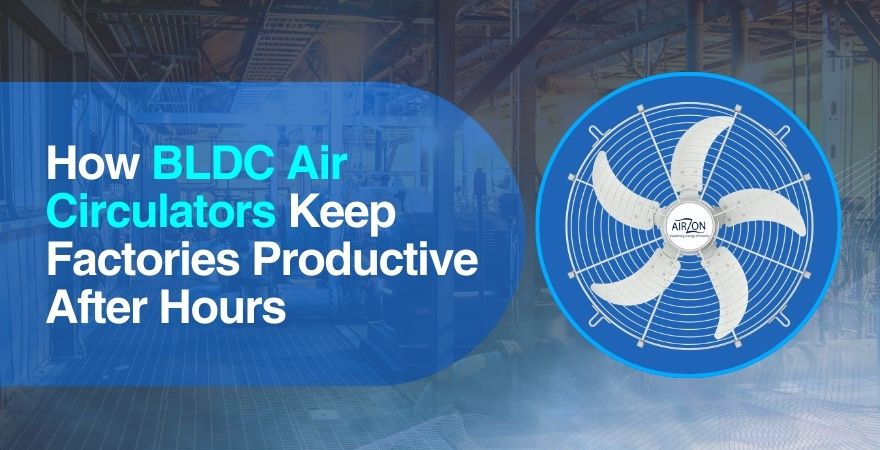
Today, the factory floor runs on BLDC air circulators engineered for continuous duty cycles.
The difference isn’t dramatic in the first hour.
It becomes clear after six.
BLDC motors generate significantly less internal heat, meaning:
- Stable airflow throughout 12–16 hour operations
- Reduced current draw during voltage dips
- Lower ambient heat around machines
- Consistent RPM even under fluctuating supply
Over one year, the plant recorded:
- Approx. 35–40% lower energy consumption per fan
- Reduction of unscheduled fan-related downtime by nearly 60%
- Noticeable improvement in worker comfort during late-night hours
Why the Night Shift Magnifies Efficiency Gaps
During night operations, facilities often experience minor voltage instability. Induction fans compensate by drawing higher current, increasing internal temperature.
Over time, this leads to:
- Faster insulation degradation
- Bearing stress
- More frequent rewinding
- Increased maintenance calls
BLDC air circulators, by design, regulate voltage internally through electronic control. Less stress. Less heat. Less reactive maintenance.
For Ramesh, this means fewer emergency calls and more predictable operations.
Design Matters After Midnight
Another silent advantage? Construction.
Plastic components, common in conventional fans, can deform under prolonged thermal stress. Over long night cycles, this leads to vibration, alignment issues, and efficiency drops.
Industrial-grade, plastic-free, all-metal BLDC air circulators maintain structural integrity even in high-duty environments.
Airzon’s approach focuses on:
- All-metal build
- Optimized curved blade airflow
- Stable operation across wide voltage ranges
- Designed specifically for industrial environments
Because at 3 AM, reliability isn’t optional.
Productivity Doesn’t Sleep
By 5:30 AM, the shift is nearly complete. Output targets are met. Machines remained within optimal temperature range. No breakdown alerts were triggered.
To an outsider, it looks routine.
But behind that smooth night shift is a silent contributor — efficient air circulation working hour after hour without overheating, without excess power draw, without demanding attention.
The night shift doesn’t need applause.
It needs reliability.
And in factories that run after hours, BLDC air circulator night shift performance is no longer a luxury — it’s operational strategy.