A warehouse never really stands still.
People are moving. Goods are being received, sorted and dispatched. Equipment is operating for long hours. In e-commerce and logistics facilities, this activity can continue across multiple shifts every day.
Yet one part of warehouse infrastructure is often treated as an afterthought: air circulation.
For a small space, the difference between one fan and another may not seem significant. Scale that decision across a large warehouse, however, with multiple fans operating for thousands of hours every year, and the choice of fan technology can influence energy consumption, operating costs and everyday working conditions.
That brings us to an important question.
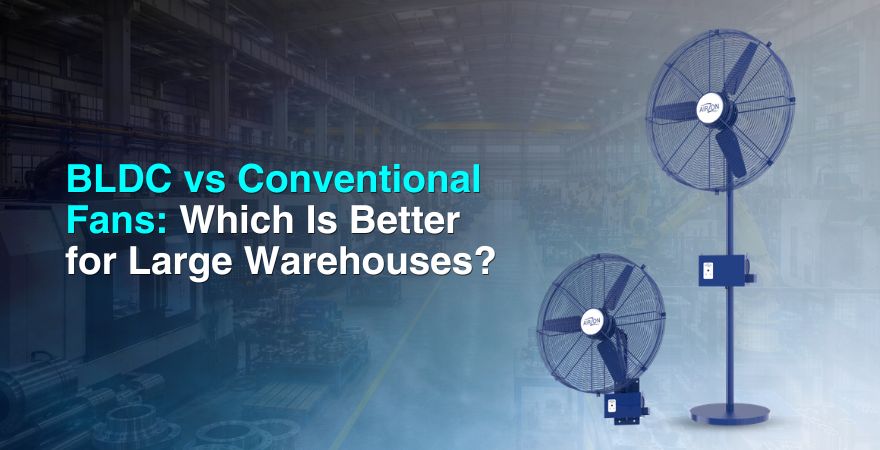
Should large warehouses continue using conventional fans, or is it time to move to BLDC technology?
Conventional Fans Work. But at What Cost?
Conventional fans have been used in industrial and commercial spaces for decades. They are familiar, easily available and often have a lower initial purchase price.
But the purchase price is only one part of the cost.
Consider a warehouse with dozens of fans operating for long hours every day.
Every additional watt consumed by each fan gets multiplied by:
Number of fans × operating hours × operating days
Suddenly, a small difference in individual fan consumption can become a considerable difference in annual energy usage.
This is why warehouse operators should look beyond the price of the fan and consider its total operating cost over its useful life.
BLDC vs Conventional Fans in a Warehouse
1. Energy Consumption
This is one of the biggest reasons to consider BLDC technology.
BLDC motors are designed for higher electrical efficiency than traditional motor technologies. When fans are used extensively, lower power consumption can translate into meaningful energy savings over time.
For warehouses operating multiple shifts, the potential becomes even more relevant.
The longer the fans operate, the more important efficiency becomes.
2. Air Circulation
Saving electricity means little if the fan cannot move enough air.
Warehouses are very different from offices or residential rooms. They may have high ceilings, long aisles, storage racks, loading areas and large open sections.
The objective is therefore not simply to install more fans.
It is to achieve effective air circulation across the required area.
A properly selected industrial BLDC air circulator can combine high air delivery with efficient motor technology, giving warehouses a smarter way to approach both airflow and energy consumption.
3. Long Operating Hours
Warehouse fans rarely operate for twenty minutes and switch off.
Depending on the facility, they may run throughout entire shifts.
That changes the buying equation.
A fan selected for occasional use and a fan selected for continuous warehouse operation should not necessarily be evaluated using the same criteria.
Motor efficiency, construction, airflow performance and suitability for demanding operating conditions become increasingly important.
4. Maintenance
Maintenance is not only a repair expense.
In a busy warehouse, maintenance can mean manpower, interruptions, replacement parts and operational inconvenience.
BLDC motors eliminate brushes from the motor design, removing one component associated with mechanical wear in traditional brushed motors.
For businesses evaluating equipment for long term operation, this is another reason motor technology deserves attention.
5. Initial Price vs Long Term Value
This is where procurement decisions can sometimes go wrong.
Suppose Fan A costs less to purchase, while Fan B consumes less electricity during operation.
Which one is cheaper?
You cannot answer that question from the purchase invoice alone.
For equipment that operates regularly over several years, businesses should consider:
Purchase cost + electricity consumption + maintenance + expected operating life
This gives a much more realistic picture of the actual cost of ownership.
For large warehouses, where the same decision can be multiplied across dozens or even hundreds of units, the difference becomes difficult to ignore.
Why This Matters Even More for Ecommerce Warehouses
Modern ecommerce warehouses are designed around speed.
Orders arrive continuously. Picking and packing operations need to move quickly. Dispatch schedules are tight. Employees and equipment may operate across extended shifts.
Warehouse infrastructure therefore needs to support the operation rather than become an obstacle to it.
Lighting has become smarter.
Material handling has become smarter.
Inventory management has become smarter.
Air circulation should become smarter too.
Choosing energy efficient air circulation equipment is not simply about replacing one type of fan with another. It is about examining an everyday operating expense that repeats itself every hour the warehouse is running.
So, Which Is Better?
For applications with limited operating hours where initial purchase cost is the primary consideration, conventional fans may still have their place.
But the equation changes considerably for large warehouses, fulfilment centres, distribution centres and logistics facilities where fans operate extensively.
In these environments, BLDC technology offers a compelling combination of energy efficiency and effective air circulation.
And that is exactly where Airzon comes in.
Airzon BLDC Air Circulator Fans
Airzon BLDC Air Circulator Fans are developed for demanding commercial and industrial applications where airflow and energy efficiency need to work together.
For modern warehouse operations, the objective is simple:
Move more air intelligently while consuming less energy.
Airzon’s growing presence in ecommerce warehouse applications, including installations for leading brands such as Swiggy and Flipkart, reflects a broader shift towards smarter warehouse infrastructure.
Because when a warehouse operates at ecommerce speed, even something as simple as a fan should be engineered to keep up.
The Smarter Question
The question is no longer simply:
How much does the fan cost?
The better question is:
How much will this fan cost to operate every day for the next several years?
For a large warehouse, that difference can change the entire calculation.
Airzon BLDC Air Circulator Fans
Built for warehouses that never stop.