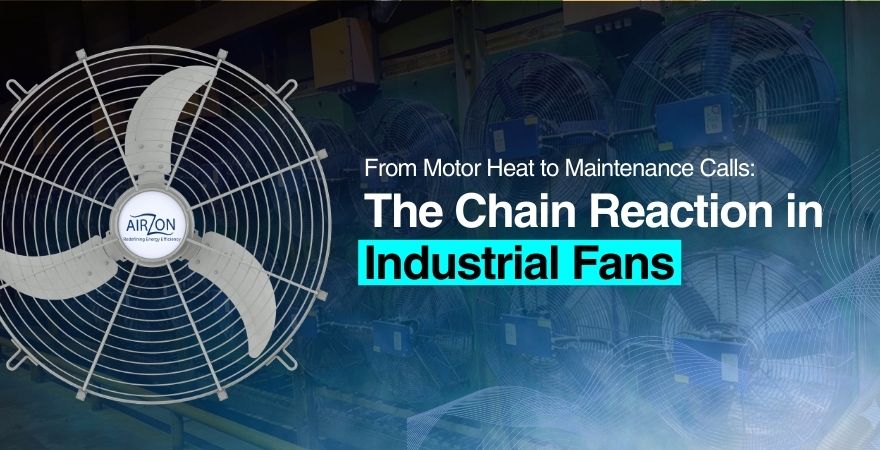
In industrial environments, fans are expected to work quietly in the background. As long as air keeps moving, everything seems fine. But beneath that steady airflow, a slow chain reaction often begins—one that starts with motor heat and ends with maintenance calls, downtime, and rising costs.
This progression rarely happens overnight. Instead, it unfolds gradually, making it easy to overlook until the consequences become unavoidable.
It All Starts with Motor Heat
Every motor generates heat. The real question is how much—and how often.
In conventional induction fans, a significant portion of electrical energy is lost as heat due to inherent inefficiencies. When these fans run for long hours, especially in factories, warehouses, and processing units, internal temperatures rise steadily. At first, this heat seems harmless. The fan still runs. Airflow feels normal.
But heat is never neutral. It accelerates ageing inside the motor.
Heat Triggers Wear—Quietly
As motor temperature increases, insulation around windings begins to degrade. Bearings experience higher friction. Lubricants lose effectiveness faster. None of this causes an immediate failure, which is why the problem often goes unnoticed.
Over time, however, the fan needs more power to maintain the same speed. Vibrations may increase slightly. Noise levels creep up. These are early warning signs—but in busy industrial settings, they’re easy to ignore.
Efficiency Drops Before Performance Does
One of the most costly aspects of motor heat is that efficiency drops long before performance does.
A fan may still deliver acceptable airflow while quietly consuming more electricity. Energy bills rise without a clear explanation. What’s actually happening is internal heat forcing the motor to work harder, drawing more current for the same output.
This hidden inefficiency continues until mechanical wear becomes severe enough to affect operation.
From Heat to Maintenance Calls
Eventually, the accumulated stress shows up as frequent maintenance issues. Bearings fail sooner. Windings require rewinding. Components need replacement. What was once a low-attention piece of equipment now demands repeated service calls.
- For maintenance teams, this means:
- Increased downtime
- Unplanned repairs
- Spare part costs
- Disrupted operations
And because fans are often installed across large facilities, the problem multiplies quickly.
Why Design Choices Make the Difference
Motor technology and construction quality play a decisive role in how this chain reaction unfolds.
BLDC motors generate significantly less internal heat because power conversion is more efficient. Lower heat means slower ageing, stable performance, and fewer mechanical stresses over time.
Material choice matters just as much. Plastic components are more vulnerable to heat deformation and fatigue. In contrast, all-metal, plastic-free construction maintains structural integrity under prolonged thermal load, preserving alignment and efficiency.
Airzon’s Approach: Breaking the Chain
At Airzon, industrial fans are designed to interrupt this heat-to-failure cycle before it begins.
Key design principles include:
- BLDC motor technology for lower heat generation
- Plastic-free, all-metal construction for durability
- Optimised for continuous duty, not occasional use
- Stable performance under voltage fluctuations
By reducing internal heat at the source, Airzon fans minimise wear, extend service life, and significantly reduce maintenance intervention.
The Operational Impact
When motor heat is controlled, the benefits ripple outward:
- Energy consumption remains stable
- Maintenance frequency drops
- Downtime reduces
- Equipment lifespan increases
The difference isn’t dramatic on day one. It becomes clear over months and years—when one facility faces repeated service calls and another runs quietly with minimal intervention.
Conclusion
In industrial fans, maintenance issues rarely appear without warning. They are the end result of a chain reaction that begins with motor heat and grows silently over time.
Breaking this chain requires smarter motor technology and durable design—not just reactive maintenance. For facilities focused on reliability and long-term efficiency, controlling motor heat isn’t a technical detail. It’s a strategic decision.